Copyright Nigel Edwards
Midland Red (Birmingham and Midland Motor Omnibus Co)
1959
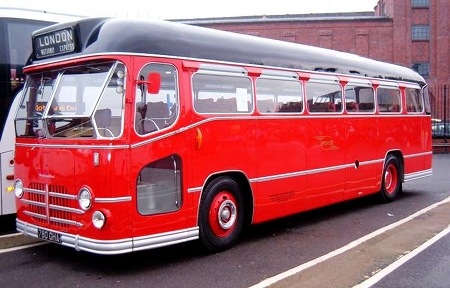
BMMO C5
BMMO C39F
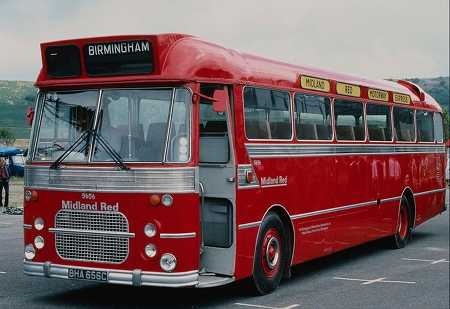
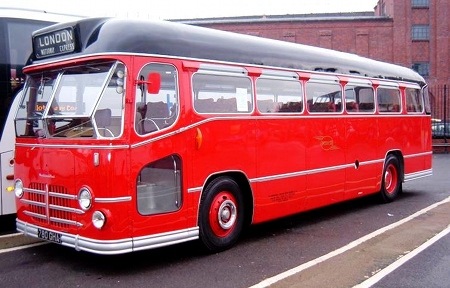
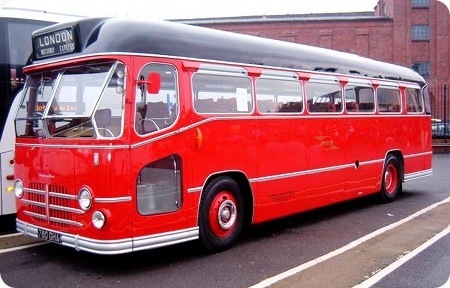
A memorable spring day in in 1960, after driving for Midland Red for a couple of years, I was delivering a motor caravan to London at a steady 60 on the new M1 and looking in the mirror I saw what turned out to be a new C5 – Motorway Express – looming towards me and finally going past at 85+ and disappearing in a flash. The very interesting book by Steve Richards on these vehicles made note of the extensive work done by Dunlop to actually design, and the difficulty of producing, a tyre that would withstand the stress of these high speeds by a truly awesome turbocharged coach well ahead of it’s time. Still, today I would argue Roger Burdett’s beautifully restored C5 -780 GHA- is a fine example of a classic.
Photograph and Copy contributed by Nigel Edwards
26/06/12 – 14:18
The vehicles this operator built were always
(a) different
(b) well ahead of their time.
It was a sad day when "outside" suppliers had to be used.
Thank you for sharing.
Pete Davies
26/06/12 – 17:51
Sadly, I never experienced one of these – but I did have the Corgi toy.
David Oldfield
27/06/12 – 07:17
So did I, David, but the special Dunlop tyres couldn’t cope with Axminster carpet, but were great on lino!
Paul Haywood
27/06/12 – 10:22
…..but lino did share certain (chemical) characteristics with the surface of the M1.
David Oldfield
27/06/12 – 13:33
There were no speed limits on motorways in the early days and it’s true that these and a few other modern coaches were capable of 90mph. With soft-shoulders, no central crash barrier and inadequate tyre technology, several accidents/near-misses occurred, which swiftly caused safety features and speed limits to be introduced. I think it was 80mph to start with, coming down to 70 later, to save fuel at the start of fuel crises that bedevilled countries in the 1960’s and 1970’s.
Chris Hebbron
28/06/12 – 07:43
The juxtaposition of this posting and the previous one, about trolley buses, is particularly noteworthy because they are flip sides of the same coin: the then irresistible dominance of the internal combustion engine. Railways were unfashionable before Beeching, being viewed as 19th century technology, (there was even a Railway Conversion League), whereas Britain’s ‘new motorways’ were seen as an exciting foretaste of new travel possibilities. The C5 was a supreme example of this fashion, along with the Ribble/Standerwick/Scout Atlantean coaches. I never travelled on one, but, like Nigel, I remember being overtaken by one on the M1 at great speed.
The fashion of the period did little for trolleys. Despite the advantages in performance and silence so cherished by my friend John Whitaker and others, their need for dedicated infrastructure, extra specialist maintenance skills, additional equipment and inventory, gave the motor bus – cheaper, more flexible and by the 1950’s very reliable – an appeal that was just far more in keeping with the climate of the times.
As Chris remarks, the generally high motorway speeds of the time did quickly become of concern, (not only coaches – much of the danger was caused not only by the points Chris makes but also by large speed differentials between vehicles). That led to the introduction of the 70 mph limit, (sorry, Chris, but it was never 80; 50 temporarily during the 1973/4 fuel crisis, but always 70 otherwise). In turn, that undermined the justification for ‘ton up’ coaches. Nevertheless. I still have happy memories of getting a Maidstone & District AEC Reliance up to 70 mph on the Swanley by-pass, and I’m sure all readers will admire the subject of Nigel’s lovely posting. Happy days indeed.
Roy Burke
28/06/12 – 07:44
In my student days in Birmingham, I normally travelled home on the Standerwick service to Lancaster, being overtaken almost every time by the Western SMT coaches which moved over only for vehicles showing blue lights. They were reputed – true or not? – to do the round trip of Glasgow, London, Glasgow in the shift.
Another story of the time related to the prototype CM6T, which was said to have been tested over a measured mile of the then still to open M1, before Smith’s Industries in Basingstoke were contracted to make the speedometers. The beast did 120, apparently, and regularly overtook the train in that glorious section near Watford Gap Services!
Pete Davies
28/06/12 – 14:30
Following on from Pete Davies’s comments regarding the testing of these C5 – and later CM6’s – a recent extract from my May copy of ‘Omnibus’ (the monthly members sheet from BaMMOT) by John Morris, further illustrates the effort that went into testing. I hope John won’t mind me quoting verbatim from his excellent article!
“At Central Works there was also a department known as ‘Development‘ which was jealously guarded from access to strangers visiting the works".
As the name implied any future improvements and new designs were carried out in this area. This included the road testing of the new CM6T London to Birmingham Motorway coaches.
On several occasions two young engineers, accompanied by myself would board a finished vehicle painted in green primer, without interior fittings, loaded with a number of 56Ib weights to form a second floor covering, with a large sofa placed behind the cab area (to provide luxurious comfort for the observers) and off we would go on a 1,000 mile road test. This would involve driving from Birmingham to the start of the M6 near Cannock and then going full pelt up the motorway at speeds of up to 100mph on the clock all the way to Charnock Richards services in Cumbria. I kid you not regarding the speed! Don‘t forget this was in the sixties and traffic on the M6 was very light and we simply stayed in the empty right hand lane all the way! I vividly remember drivers of sports cars probably doing 80mph looking at us open mouthed as this large green machine drifted much faster past them.
At Charnock Richards we would have a pleasant lunch and then back to Birmingham. This trip would be repeated next day after minor adjustments until 1,000 miles had been covered. Once the testing was completed the CM6T would be passed fit for service and handed over to final assembly for ht out and painting.”
Nigel Edwards
28/06/12 – 15:58
I have to say that the CM5T was an absolutely splendid looking machine. The red and black livery, relieved by polished trim was really classy. The windscreen arrangement was rather reminiscent of Dutch coaches of the period. The windows may have been unfashionably small – presumably it was based on the S14/S15 body shell – but it was probably a stronger structure than the panoramic coaches that were starting to appear at the same time. Maybe not strong enough to withstand a collision at over 100mph though.
I never rode on a CM5, but I did once travel from Birmingham to London on a CM6T, and must say that it was the most comfortable, smooth and quiet riding coach I have ever ridden on. The Yorkshire Traction Leopard employed on my return from the capital to Halifax came nowhere near.
I also had the Corgi model (still have, and still in its box). Its suspension was also very smooth, but it lacked the chromed windscreen metalwork that gave the real thing its distinctive appearance. It was also a larger scale than the rest of my Dinky Toy bus collection, so had to be parked well away from the others in Sideboard Street Bus Station before the long journey to Coalplace via Kitchen and Garden Path.
John Stringer
29/06/12 – 07:51
Thank you, Nigel, for your quotation from the newsletter. It confirms that at least some element of the stories circulating in my student days was correct. The run to and from Charnock Richard – it’s near Preston, by the way, not in what the political meddlers like to call Cumbria – would have given a good test of performance in "real" traffic.
Pete Davies
29/06/12 – 07:52
John,
That was the exact route I used to operate with my Dinky Duple Roadmasters and Leyland halfcab deckers but I used to get a fair turn of speed up on the long straight Bannister Way on the route to Under Mumsbed bus station!
I also had the Corgi model but never used it much because I thought it looked too big. Wish I still had it.
Eric Bawden
29/06/12 – 11:16
I remember vividly as a child of about 8 yrs sitting behind the driver of a late to depart out of Nottingham Broadmarsh bus station a Barton’s Yeates bodied Bedford Val and travelling along the A52 which is a single carriageway by Wollaton Park gates at speeds in excess of 70 mph, I thought it was great but my father was quite worried for all the passengers safety as the speed limit was 40 mph !
Roger Broughton
29/06/12 – 11:20
There was another model of the CM5T made by Budgie Toys, and it was more like 1/76th scale, but I must say I never came across one in those halcyon, carefree, childhood model bus operating days – the only Budgie Toys bus I ever had bought was a Routemaster, whose wheels were just slotted onto the ends of the axles and came off every time it went round a corner. Not all they were cracked up to be, Routemasters.
John Stringer
29/06/12 – 17:13
Just on the subject of speedo’s, I joined Armstrong Galley in 1975 an even then all our coaches were fitted with tachographs, this was about two or three years before the legislation making them compulsory came in. As we all know the primary speed register on tachos is displayed in KPH with MPH in much smaller figures, and I well remember one occasion when I was on the M6 and a small boy who was sitting about two seats back got up and came to look over my shoulder, he announced to everyone that we were doing over 110 miles per hour
Ronnie Hoye
30/06/12 – 05:20
We’ve all been there Ronnie. I was once reported by a passenger for doing 60 in a 40 limit. 60kph = 40mph (approx.).
David Oldfield
30/06/12 – 05:21
You’d be surprised at the number of drivers who have been reported to their employers by passengers peering at the speedo’/tacho’ face and mistaking KPH for MPH.
John Stringer
30/06/12 – 05:22
Thanks for that snippet, Ronnie. In case anyone was wondering what the difference in accuracy between a tacho and a speed camera, there was a case in one of the trade magazines about a year before I retired – so about 5 years ago now – where a truck driver had been zapped at about 35mph in a 30 zone, but his tacho said he was doing 28 at that time.
In court, the Magistrate agreed to send both items for test, with the result binding. Driver was cleared and they scrapped the camera!
Pete Davies
01/07/12 – 09:52
The Val was doing 70 mph not kph as it was well before tachos were being fitted.
Roger Broughton
27/09/12 – 07:08
Regarding Chris Hebbron’s comments on speed limits (27/06/12), the 70mph limit came in under Barbara Castle’s regime as Minister of Transport. After a trial period in 1965, it was made permanent in 1966 – there was no intermediate 80mph limit.
The fuel related speed limits were applied in the winter of 1973/4 as a result of the combined effects of the oil shortages following the Yom Kippur War and the Miners’ Strike/3 day week. The maximum speed limit then was 50mph on all roads previously restricted to 70mph, including motorways.
The introduction of the "fuel saving" limit coincided with a massive rise in prices and was widely resented.
Midland Red motorway services were renowned for their high speed and comfort. There were a number of accidents but 90mph on a C5 would have been much less hairy than 60mph on the top deck of a Standerwick "Gay Hostess" Atlantean.
Phil Blinkhorn
26/10/12 – 14:21
On the 14th October 2012 during Wythall’s Midland Red day, I rode on the preserved CM6, 5656. The driver took it along the dual carriageway Wythall bypass and let her go. When I asked how fast was that, he replied ‘Off the clock, mate!’ Not bad for a 47 year old coach!
Tony Martin
26/10/12 – 16:49
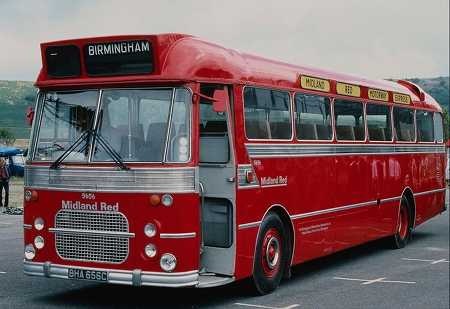
Thought others might like to see the CM6T referred to by Tony Martin. Thankfully the weather didn’t spoil the "Midland Red day", great to see these restored examples at work again.
Nigel Edwards
06/11/12 – 06:40
On the subject of passengers reporting drivers for excess speed I well remember being approached by a male passenger who I had just seen get off one of our Bristol VRs who stated quite vehemently that he intended to report its driver for speeding because sitting in the O/S front seat on the top deck he had for some reason looked down the periscope tube and could see the speedo very clearly (which you could ) and it was reading 80 mph obviously dangerous on the road the bus was using. If only, 50 mph was a good speed for any VR, I pondered on telling him of the kph/mph scales on the speedo but decided to let him make a fool of himself knowing that the driver was able to easily prove his innocence.
Diesel Dave
12/09/14 – 17:40
I agree with Nigel Edwards. In late 1959 I went from B’ham to London with my father, who was running-in a new Austin Cambridge A55 Farina (718 AOG) on the M1, bouncing along merrily at 50 to 60 mph. I was 8 yrs old and vividly remember being rapidly overtaken, and left for dead, by a big red C5MT, which was rock steady – most impressive! I have read that even after the 70 mph speed limit came into force in 1966, the coach timetable from Digbeth to Victoria, still expected the original speed of c.85 mph to be maintained on the M1/M45. Yes, I did go on to become an engineer.
John Mitchell
05/10/14 – 11:02
Very interested in Midland Red C5…actually drove one when I was at Worcester Garage on X72/73 Service.
Also interesting to see that Mr Burdett owns one…he now owns my Tilling-Stevens, GOU 732…ex-Classic Coaches of Wombourne. It’s good to know she’s gone to a good home.
Bedford O.B., MYB 33, is now owned by Stuart Jones, Editor of Bus & Coach Buyer…another good home. Sadly the AEC narrow-bodied PLaxton, EUG???D was not so lucky.
Harry ‘Bob’ Harris
06/10/14 – 13:45
John, Difficult now to comprehend, the specially selected drivers had to be trained in ‘high speed driving techniques’ and never needed to resort to flashing light intimidation – the other motorway drivers (and truck drivers) saw them coming and just pulled over. What a joy to drive these coaches then, compare with today – second lane and lucky to achieve 55mph !!
Nigel Edwards
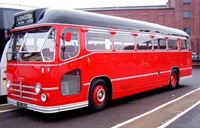 Vehicle reminder shot for this posting
23/10/14 – 16:16
Now in my dotage I have been remembering some of the things when! I drove on the Midland Red late 60s early 70s out of Banbury Garage where we had a couple of C5s an ideal tool for the rural routes around North Oxfordshire, the only alteration to their Motorway work was that 5th gear was blanked off but still they had a good turn of speed in 4th! They were beautifully softly sprung and when my sister was 2 weeks overdue with her first child I would pick her up from Rollright and storm back to where we lived in Bloxham in an attempt to induce her!
Did hear tell of a driver on the Birmingham-London service being passed by a fully freighted Kew Dodge.
Charles Henderson