Photograph by ‘unknown’ if you took this photo please go to the copyright page.
Newcastle Corporation
1949
Leyland Titan PD2/1
Leyland L27/26R
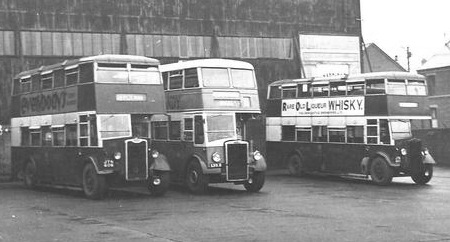
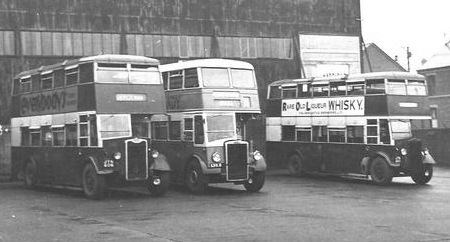
Yet again another shot from the job lot of shots I bought at the market I’m afraid there is no information on the photo. But staying on the low bridge theme of Newcastle Corporation that I have been posting, here is a line up of three Newcastle low bridge double deckers. Between 1948/9 Newcastle took delivery of quite a number of all Leyland Titans, among them were 6 low bridge variants – LVK 6/11, fleet numbers 354/9 – 359 pictured. They replaced 4 pre war Daimlers BTN 100/3 (fleet numbers unknown) and for a while they ran alongside these utility Guy Arabs, the two in the photo are still in the blue wartime livery. Unfortunately I cant find any information about the Guy’s as regards fleet numbers, Registrations or bodybuilder etc.
Photograph and Copy contributed by Ronnie Hoye
27/07/12 – 08:37
The two Guy Arabs appear to be of the Mark 1 type with the short bonnet. The bodywork seems to be the standard Brush utility L27/28. Unfortunately, I do not have access to a Newcastle fleetlist to confirm.
Roger Cox
27/07/12 – 08:38
Unlike many of our number, I cannot whip up any enthusiasm for utility bodywork. On the other hand, I have boundless enthusiasm for the all Leyland PD2 – especially the earlier examples and the final version. The true Faringtons, with their separate ventilators, did nothing for me. Sheffield had going on for 150 of the early all Leyland PD2s (but all Highbridge) as well as numerous Faringtons and 12 of the superb last version.
As an AEC man from an early age, I always loved these PD2s with an almost silent tick-over (and a distinctive beat) and superbly finished bodywork. Luckily when Leyland gave up on coachwork in 1954, Sheffield continued to buy these wonderful beasts with top quality bodywork by Roe and Weymann (pre Orion). Similar Roe and Weymann bodywork also sat atop Regent IIIs and Regent Vs – the old dual sourcing in action.
David Oldfield
27/07/12 – 08:41
Well, our anonymous photographer has produced another gem. I, for one, never knew Newcastle had blue buses. Equally, I once photographed a red Bury bus at a rally. When I reported this to my father, he said he remembered them in red, and they had changed to green post-war.
Pete Davies
27/07/12 – 15:42
Pete, I’m pleased to say that a preserved example of Newcastle’s all Leyland PD2’s ‘LVK 123’ is still alive and well and is part of the N.E.B.P.T. Ltd collection, it’s a 1948 highbridge example and has been restored to it’s original blue and cream livery, as per the Guy’s in the picture. At the beginning of 1949 ‘half way through production of the order’ the livery was changed to the yellow and cream with maroon line out and red wheels which most of us will be more familiar with. I’m not sure if the low bridge vehicle in the picture pre dates that, but it wasn’t unusual for some block batch registrations to be held back and issued to later vehicles, I suspect that’s the case here and this is from the 1949 batch, I think it took about two or three years to change the whole fleet and being the newest I would think the blue PD’s would have been at the back of the queue
Ronnie Hoye
27/07/12 – 15:42
Newcastle had blue buses until the nineteen fifties the Northern Coachbuilders bodied AEC Regents being the first yellow buses delivered new One of the LVK batch of PD2s has been restored to the blue. In contrast Newcastles trolleys were yellow from the start.
Chris Hough
27/07/12 – 15:43
The photograph is a real gem and illustrates the difference between wartime utility bodywork and the standards on the return to peace.
In 1942 Newcastle Corporation received 2 Guy Arab I with Massey H30/26R bodywork numbered 245-46 JTN 505-6. They were withdrawn in 1950. Another 2 Arab I with bodywork by Strachans L27/28R were received in 1943, numbered 247-48, JTN 607-8. These are recorded as being withdrawn in 1950, with 247 going to Darlington Corporation as a driver training vehicle.
The Leyland Titans 6-11, LVK 6-11, were new in late 1949 and would have been among the first motorbuses delivered in cadmium yellow livery, which hitherto had been applied to trolleybuses only.
I hope this information is helpful and thank you for posting some wonderful photographs.
Kevin Hey
28/07/12 – 08:53
As mentioned elsewhere and by others in these pages, it really is amazing what previously unknown (or forgotten) information surfaces in response to the publication of a photograph. Keep up the good work, gents!
Pete Davies
28/07/12 – 12:11
As Kevin points out, Newcastle had two fleet colours, Trolley buses were yellow and motor buses blue, that all changed in 1949 when all vehicles adopted the trolleybus livery, still with me?. Some time later all the fleet numbers were changed, existing trolley buses up to 99 were renumbered starting with a 3 in front, 100 became 400, and any new vehicles carried on from their with 628 being the last, this meant that motorbuses were also renumbered and 359 pictured above became 11. Confusing isn’t it?
Ronnie Hoye
28/07/12 – 12:19
The lowbridge Arab 1s with Strachan bodies supplied to Newcastle were part of a batch originally intended for London Transport, before they successfully switched the requirement to CWA6 Daimlers D1-6. Bradford got one too, No.467. Not sure where the others went without looking the details up.
John Whitaker
28/07/12 – 15:54
Ronnie, I think that the pre-war and wartime trolleybus fleet was renumbered in 1946 and the fleet number for the beginning of the postwar trolleybuses began at 443 – although the first trolleybuses to be received after the war were the 20 BUT Q1s starting at fleet number 479.
The motorbus fleet was not re-numbered enbloc, although some renumbering of batches occurred. In March 1963 6-11, LVK 6-11 became 354-9 in order to vacate numbers for the impending delivery of 25 Leyland Atlanteans that became 1-25, 1-25 JVK, with bodywork split between Alexander and Weymann as was customary practice with Newcastle Atlanteans until 1966.
Similarly,in March 1966 Leyland Titans 115-36, LVK 115-36 were renumbered to 415-36 to create space for a batch of 28 Weymann bodied Leyland Atlanteans 106-33, KBB 106-33D. The remainder of the 1966 delivery was 26 Alexander bodied Atlanteans which became 239-66, KBB 239-66D. I believe that these batches were originally to have been numbered in a single series 401-56, JVK 401-56D.
I hope this clarifies things. As you say, it was confusing!
John’s comment about the Strachans bodied Guys being part of a batch originally intended for London is very interesting. The topic of wartime deliveries and the role of the Regional Traffic Commissioners and Ministry of War Transport is one that is ripe for studying.
Kevin Hey
28/07/12 – 19:10
Expanding on John W’s comments, LT was allocated eleven unbuilt lowbridge Guys from Strachans and four from Northern Counties. It only needed thirteen. Strachans bodies did not impress them, from LGOC days, and NC were an unknown quantity. LT found that they were three inches too high than their preferred height. Strachan offered to build the bodies to LT’s required height, but this would have entailed eliminating one step from the staircase, making one of the remainder too high for comfort. LT then wanted to build thirteen of its own lowbridge STL bodies for the Guy chassis (like the earlier, unfrozen ones) but was forbidden to. It was the two surplus Guy/Strachans to LT’s needs which went to Newcastle, in May 1943, fleet numbers 247/248 (JTN 607/608). Both vehicles were reconditioned after the war, but were disposed of in 1950.
Chris Hebbron
28/07/12 – 19:12
I agree Kevin; wartime allocations were fascinating!
This is another complicated story, well told in Ken Blacker`s book, "London`s Utility Buses". London managed to persuade the powers that be, to allow them to build some STL pattern lowbridge bodies, and this enabled them to avoid the 13 Guys mentioned. Some were actually bodied by NCME, but the Strachan variety were disposed of as follows:-
Potteries. JEH 472/3
Aldershot & Dist. EHO 695
Red & White EWO 484
Skills (Nottingham). GTU 427
Bradford Corporation. DKY 467
South Shields Corporation. CU 4549
Newcastle C.T. JTN 607/608.
The Bradford bus finished up as a "school bus" (tuition vehicle), and thus lasted well into the 1950s, and consequently into my memories.
John Whitaker
29/07/12 – 11:03
Sorry, Kevin, I got it the wrong way round, but why make it so complicated when the whole thing could have been done by adding a letter to the begining or end of the existing number. A simple system could use F – R – S – T. ‘F’ could be either front entrance or front engine, the same would apply to ‘R’ – ‘S; would be single deck and ‘T’ Trolleybus, but I’ve just seen a flaw in that idea, you don’t need a university degree to work it out, or am I just being cynical?
Ronnie Hoye
30/07/12 – 10:58
Ronnie, an interesting idea. Most municipal fleets used a pure numeric system for fleet numbering rather than alphabet-numeric. Two fleets that used the latter were Glasgow and Liverpool, although Liverpool began the process of moving to pure numeric a short while before being transferred to Merseyside PTE. Stockton-on-Tees began using alphabet-numeric some years before being merged with Middlesbrough and TRTB to form Teesside Municipal Transport. There may well have been others but I can’t think of any. Still, if I have missed some then I’m sure that someone will add a comment or two to complete the picture.
The renumbering of some of the Newcastle motorbus fleet in the mid-1960s was a consequence of the very large numbers of motorbuses that were delivered in a very short period of time for converting the trolleybus system to motorbus operation. By 1954 the motorbus numbers had reached 354 and the next deliveries in 1956 began at 137 (after the 1948 high-bridge Leyland Titans that ended at 136). As an aside, in 1957 this necessitated renumbering the Daimler CVD single-deckers 164-73 to 364-73 so that new deliveries of motorbuses could continue to be numbered in sequence. By 1962 this sequence had reached 238 and there was a gap of 12 numbers vacant to the start of the 1949 batch of AEC Regents that started at 251.
The undertaking had ordered 25 Leyland Atlanteans for delivery in 1963 and these were numbered from 1 upwards. By 1965 this sequence had reached 105 and was encroaching on the 1948 high-bridge Titans that began at 115. Of course, even renumbering the Titans to be 415-36 was insufficient to accommodate the entire batch of 56 Atlanteans due in 1966 and half of them was numbered 106-33, and the other half 239-66. I would be interested to hear of the reason for the original plan to number these 401-56 not proceeding.
Finally, a word for John. When I joined Bradford City Transport immediately prior to the formation of the West Yorkshire PTE, the driving school was in the capable hands of Inspector Harold Gobby, although for the life of me I cannot remember where it was based. The conducting school, which was based in the basement of the Forster Square offices, was in the hands of Inspector Joseph (Joe) Straughton. Ah, happy days!
Kevin Hey
30/07/12 – 16:02
You should be able to tell us a tale or two, Kevin.
I suppose it was Leylands in Inspector Gobby’s day, although one of the Crossleys replaced 467 for a time in 1958. Was the trolleybus driving department under the same control?
I left Bradford in 1968, but it will always be my favourite fleet!
John Whitaker
31/07/12 – 05:50
During my time as an Instructor at Yorkshire Rider/First Halifax, the earlier pages of the PSV Test Results Book showed several tests conducted for WYPTE/Metro Calderdale in the mid-seventies by an examiner called H. Gobi.
John Stringer
23/12/12 – 08:05
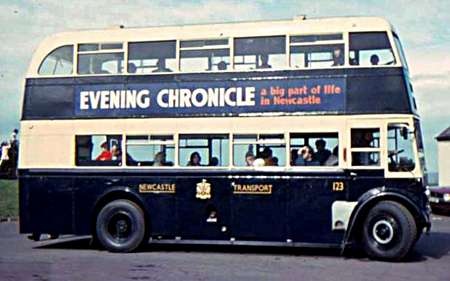
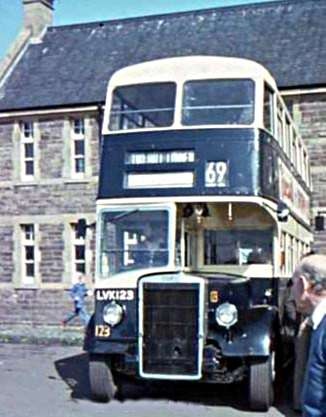
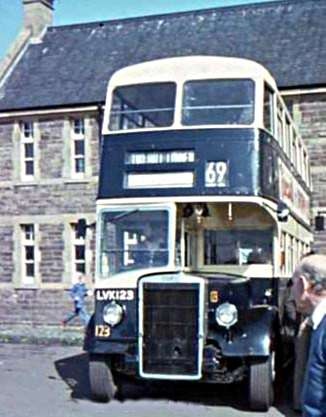
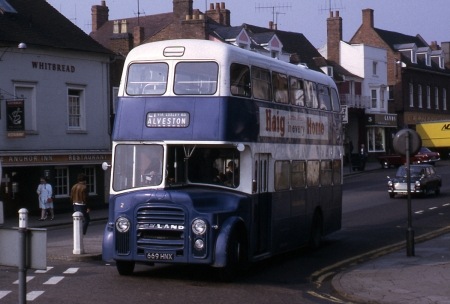
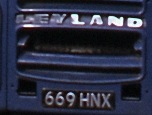
Further to the discussion on Newcastle Corporation Leyland bodied PD 2/3s here are two photographs I took of LVK 123 at the 1977 Dunbar Rally.
Gerald Walker
23/12/12 – 13:44
Kevin is more of an authority on this subject than I am, but if my information is correct, LVK 123 is actually older than LVK 11. Newcastle Corporation placed an order for these Leyland’s to be delivered in 1948/9. Most of them were the high bridge type, but the order also included 6 of the low bridge variants. Registration numbers were issued as a block, but as is often the case with large orders the vehicles are not necessarily delivered in numerical order. Up to 1949 Newcastle had two liveries, motor buses were blue and trolley buses yellow. Whilst these vehicles were being built it was decided to standardise the whole fleet in the trolleybus livery, but by that time part of this order had been completed and among others, 123 was delivered in blue, the remainder, including LVK 11, were delivered in yellow. Unless the normal repaint process was accelerated to speed up the livery change, 123 would have been blue for about three years
Ronnie Hoye
26/12/12 – 07:16
A question for Ronnie – and others! – about an anomaly in Newcastle post-war panel numberings, triggered by Ronnie’s comments about allocation of registrations. Newcastle ‘started again at 1’ with panel numberings after the war, with a batch of five CWA6s taking numbers 1-5 (albeit delivered over a three-year period, 1, 2 and 5 in 1945, 4 in 1946 and 3 in 1947, all with second-hand pre-war MCCW or PR bodies). Another batch of fourteen CWA6s with Massey bodies came next, in 1945 and 1946, but numbered 13-26. The numerical gap between these batches wasn’t filled until 1949, by the low-bridge Leylands 6-11. By this time other deliveries had taken numbering in the new series beyond the 100 mark. Does anyone know the background to this? It’s often puzzled me.
Tony Fox
26/12/12 – 15:42
Never having seen anything on paper I cant answer that one, Tony. It must have made sense to someone, but Newcastle seemed to make a simple system of numbers based on the registration far more complicated than it need be, some vehicles retained their number the whole time they were part of the fleet whilst others were renumbered at least once, and in the end some fleet numbers bore no relation to the registration. Speaking for myself, I would have used a simple pre or suffix system of letters to denote either vehicle type or the year they joined the fleet, that way you could still use the registration numbers as part of the fleet number and never need to change it, regardless of how many vehicles you had. London Transport for example
Ronnie Hoye
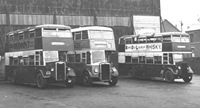 Vehicle reminder shot for this posting
09/09/14 – 18:00
I remember the so called "Blue Buses" Daimlers very well.
They had preselector gearboxes which must have been a boon for the drivers and low down on the inside left a Notek Fog lamp – very famed and desirable by many! – which was very necessary in the old days of coal fires and heavy industry which caused very extreme smog on Tyneside/North of England.
Another unique feature of the older Daimler buses with registrations from FVK 197 on was they had next to the front destination screen a 5 inch blue light!
No other Newcastle bus photos? I remember so well the Haymarket bus station with a real mixture of buses/coaches from Northern – United Automobile Services and of course Newcastle Corporation Transport!
Stuart Beveridge
10/09/14 – 07:00
Kevin H, John W, John S – I recall that when the Bradford trolleys finished in 1972 it was reported that the last trainee to pass his trolleybus driving test did so a few weeks earlier, and the examiner was an Inspector Gobbi – at least, that’s how I think his name was recorded at the time. Gobby, Gobbi, or Gobi, I presume it’s the same gentleman being referred to.
David Call
10/09/14 – 18:00
In WYPTE days this gentleman had carried out a number of PSV Tests for Calderdale-based trainees, and his name was recorded in the Driving School’s Test Results record book as H. Gobi.
John Stringer
10/09/14 – 18:00
In his original post Ronnie mentions he can’t identify the body builder of the Guy utilities and, though Kevin Hey lists the two Strachens bodied vehicles Newcastle had, there is no direct tie up to the photo though it is obvious that the bodies are not by Massey, who built the first two delivered. To state the B******g obvious, to quote Monty Python, the Arabs in the photo are the Strachens bodied examples, JTN 607 and JTN 608, close examination shows JTN 608 is on the left.
Phil Blinkhorn