Old Bus Photos

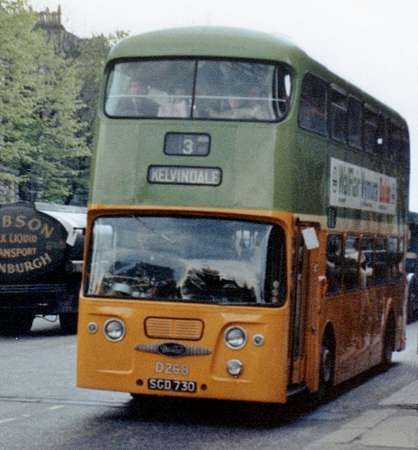
Glasgow Corporation – Daimler Fleetline – SGD 730 – D 268
Glasgow Corporation - Daimler Fleetline - SGD 730 - D 268
Copyright David Lennard

Glasgow Corporation
1963
Daimler Fleetline CRG6LX
Alexander H44/34F

Sorting through my photos recently I came across this shot taken I think in the late sixties in Glasgow. Whilst at a quick glance it looks like any of the Corporations large fleet of Atlanteans. But, a closer look shows it to be D268 their one and only Daimler Fleetline, delivered in 1963 with a body identical to the previously mentioned Atlanteans some of which were delivered with Albion badges. I have a slightly blurred photo of one of these if anyone is interested. Why Glasgow never bought any other Fleetlines in view of the number of CVG,s they had previously bought I do not know, perhaps someone may be able to enlighten me. I vaguely remember taking the photo somewhere near the Botanic Gardens I think, again I am ready to be corrected.

Photograph and Copy contributed by Diesel Dave


09/01/13 – 05:42

I’d heard of Kelvingrove, but Kelvindale is a new destination to me.

Jim Hepburn


09/01/13 – 16:01

Information about Kelvindale can be found at //en.wikipedia.org/. or at //kelvindale.org.uk/

Ken Jones


10/01/13 – 17:50

Looking at this photo now makes me realise the Glasgow Alexander body design was a true classic and probably the most successful of the first generation rear engined body designs. In fact it doesn’t look to dated when set against the modern offerings on the low-floor chassis of today.

Philip Halstead


11/01/13 – 08:06

Somehow, the low height version of the body looked even better and, yes, it wouldn’t look out of place on today’s streets. Other 1960s bodies which would still look up to date would be the Mancunian, especially the 33ft version and the 1968 Park Royal body on Sheffield’s Atlanteans.

Phil Blinkhorn


13/01/13 – 07:37

Phil: I couldn’t agree more about the Mancunian; I was impressed with it from the outset. Although many people deride its squareness, I find it stylish, of its time, and yet timeless. Manchester took the bull by the horns by creating a brand new livery that was totally suited to the body.

Alan Murray-Rust


14/01/13 – 13:17

About Philip H’s comments and the Fleetlines….Have to agree that in design terms, they are probably ‘up there’ with the true classics of their time….I remember the first time I saw a NWRCC example in Mersey Square and standing fixated for what might have been fifteen minutes at just how futuristic they looked compared to everything else around them….But a question to those of you who are far more technical and knowledgeable than myself….Were the windscreens on these Fleetlines the same piece/part/whatever as the those on the NWRCC Alexander bodied PSU3/4R Leopards?? And was the upstairs front windscreen on the Fleetline the same piece/part/whatever as the rear window on the PSU3’s?? I’ve often wondered whether the size/shape of what at the time were fairly huge single pieces of shaped glass just Alexander’s ‘brand design’ or whether it was actually a very clever innovation by them to reduce component/stock requirements in their manufacturing process which just happened to turn out right aesthetically….

Stuart C


14/01/13 – 15:32

Stuart C the answer to both your windscreen questions id yes. Economy sometimes can be translated into a timeless design!!

Phil Blinkhorn


14/01/13 – 15:59

I agree entirely with Philip on the timelessness of this Alexander design. Modern double deck body builders seem to compete with each other to accommodate the greatest area of frontal glass. Replacement costs must be astronomic.

Roger Cox


12/03/13 – 06:33

Stuart, both screens were used on the Alexander Y Type single decker – in fact, the entire GRP moulding of the upper dome was used!

Anon


19/08/13 – 07:20

The bus was based at Maryhill garage from 1964 approx where I was a driver and have driven the Daimler many times on service route 3 which ran from Mosspark to Kelvindale. The Daimler was not first choice of the drivers the doors were operated by way of the gear stick. You had the normal gear change with an additional slot for opening and closing the doors the bus had to be at a halt before you could open or close the doors resulting in late running, hope this helps.

Frank


20/08/13 – 06:32

Truly understand where you are coming from Frank.
When I was driving at Swinton for LUT, we had 2 of the first batch of dual doored Daimler Fleetline 33 footers, nicknamed ‘Jumbo’s. They were fleet nos 360 & 361, ATC 273 & 4 J. Although there was no agreement in place with the TGWU for their use as one-manners, Management was adamant and Supervisory staff were were made to frequently check that they were being used, even in crew operation, as dual door buses, in what they saw/said was their ‘pending’ one man introduction. The problem with them, was the Doors ! The front door was air pedal controlled, but the REAR door was electronic, via a sixth gear position on the selector. The gear selector would not move until the rear doors, which had an electrical sensor, confirmed that they had closed. Well, even on the moderately timed 38 service, where they were allocated, this slow & time consuming operation meant that time was lost at every stop. I tried with my guard one day to use a ticket roll to tape off the centre door on a very busy trip (17:20 hours) out of Manchester one evening, but was caught by a ‘checker’ and reported for not using the centre doors. I think I had the last laugh however, as I found that by pushing the ‘Master switch’ to off, the centre doors closed automatically and the gear selector was released ! – but this trick needed two hands to perform.
Happy Days

Mike Norris


23/09/13 – 06:00

Diesel Dave thanks for your photo of Daimler D268 you are correct the location is at Botanic Gardens at the intersection of Byres Road and the Great Western Road hidden by the tanker to the left of Daimler D268 is the rest room then used by bus staff for meal breaks.

Frank


24/09/13 – 09:28

On the subject of modern classics I would add the Leeds Roe dual door Fleetlines and Atlanteans to the list together with the ECW body for Olympians and VRs. Anyone any thoughts on these or others to add to the list.

Chris Hough


09/01/17 – 06:49

I used to be a regular schoolboy user of the 3 route. I remember how exciting it was when on one morning at the Kelvindale terminus an "Atlantean" turned out to be Fleetline D268. There never seemed to be as many 3s as 20s or 58s on Great Western Road. I recall once literally praying that a 3 would come. And it did, very promptly, except it wasn’t going to Kelvindale, it was a short working to Botanic Gardens. I’ve often wondered how often these short workings occurred, as I can’t definitely recall any others. Possibly Frank, or someone else, might know.

Moray


04/02/17 – 09:30

I worked as a conductor at Parkhead Garage during 1972/73, and vehicles were often "turned short", usually due to late running, crew shortage, or vehicle breakdown (by the time a replacement vehicle was put on the road part of the journey would be "lost"). The timetables only listed the theoretical departures from the termini concerned, although estimated journey times between principal stops were also given. However, these referred to rush hour conditions, and the actual running times were often less than those printed in the timetable book. We had a 4 bus allocation on service 38, where the bulk of the journeys were shared between Gartcraig and Newlands. On several occasions when heading back into the city from either Rouken Glen or Clarkston, we would be stopped by the timekeeper at Shawlands Cross and told to change the destination to show "Alexandra Park" instead of Riddrie or Millerston. Our last stop would be outside the Corporation crew "bothy" at St Rollox bowling green in Alexandra Parade, where we should have been relieved by another crew. However, if any of the crew were not available, we would then be instructed to run to Parkhead Garage. We were expected to run there in service along Edinburgh Road, but the reality was (despite the rule book) that Glasgow Corporation buses only picked up on garage journeys when travelling along the recognised route. As one of the bigger garages we had a few duties where we went out to assist on other services, and we would end up on 41s, 64s, and hospital specials on services 11 and 16 Sundays. There were also scheduled crew duplicates on OMO service 55 at peak hours, where we ran back to Parkhead Garage from Barmulloch, showing service 55 all the way eastwards along Duke Street. Great days for people like myself who liked a bit of variety at work. If we actually managed to get 4 buses out on the 38s all day it was a bonus. In later life I did 11 years as a driver for one of the large companies in a rural area, but it was nothing like the old Corporation.

John W


28/03/19 – 07:19

Two years on from the above, but in 1973-4 I lived right by the Botanic Gardens short turning point, which coming from the city was left into Kersland Street, where there was an alighting stop, then first right into Vinicombe Street, and back up Byers Road and back to town. I recall that some 58s, on Saturdays only, were timetabled to do this, other occasions were random. The side streets were lined with parked cars both sides, but the buses squeezed past any oncoming car.
One evening peak an Atlantean had unloaded, and turned right into Vinicombe Street, only to come nose-to-nose with, of all things, an Alexander (Midland) PD3 coming the other way, doing a short inward working from Great Western Road and turning by the same streets to go back out of town again. This was an unusual working but happened occasionally. Unfortunately I couldn’t hang around to see how they sorted it out.

Bill


14/05/19 – 06:22

Working at Partick Garage 1969 til 1974 I passed my test at Knights Wood Garage when I turned 21. I drove Leyland Atlanteans including LA1 which is now in the museum. My first driving job was in the evening rush hour on an AEC with neither power nor self centring steering. Today’s drivers would struggle with these vehicles. I am now back in my home city of Nottingham.

Melvyn Hill


Quick links to the  -  Comments Page  -  Contact Page  -  Home Page


Walsall Corporation – Sunbeam F4 – ADX 191 – 353

Walsall Corporation - Sunbeam F4 - ADX 191 - 353
Copyright Tony Martin

Walsall Corporation
1950
Sunbeam F4
Park Royal H30/26R

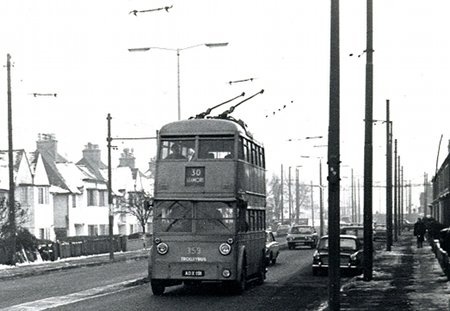
On a snowy day in February 1967 Walsall Corporation trolleybus 353 is on a short working to Leamore. The vehicle was an ex-Ipswich Corporation Sunbeam F4 with Park Royal body which was acquired with seven others due to the closer of the Ipswich Trolleybus system in 1962/3. In the background is the Carl Street entrance to Birchills depot.
But don’t worry, the Summer of Love is just around the corner! (Not that it ever reached Walsall…)

Photograph and Copy contributed by Tony Martin

———

04/01/13 – 06:49

The Ipswich destination box was an odd shape and it is strange how Walsall retained it, even going to the trouble of having blinds made to fit. With Walsall’s flair for bodywork rebuilding one would have thought they would have rebuilt these to their standard layout.
Accommodating the long word ‘Wolverhampton’ on these blinds meant writing the word diagonally.

Philip Halstead


18/10/13 – 07:41

Used to live about there on Bloxwich Road – watching some of the conductresses trying to switch the points into Carl Street could be amusing, but the sound of a trolley bus starting off from the stop outside our front window has lived with me for 60+ years ….

ex ENOC conductor


Quick links to the  -  Comments Page  -  Contact Page  -  Home Page


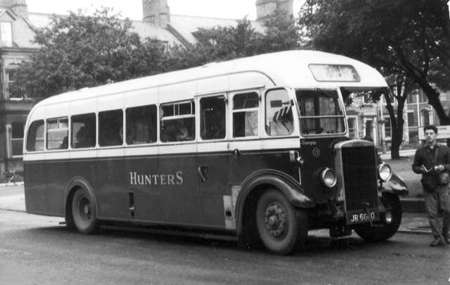
Hunter’s – Leyland Tiger TS7 – JR 6600 – 21

Hunter’s - Leyland Tiger TS7 - JR 6600
Photograph by ‘unknown’ if you took this photo please go to the copyright page.

H W Hunter and Sons
1937
Leyland Tiger TS7
Burlingham B35F

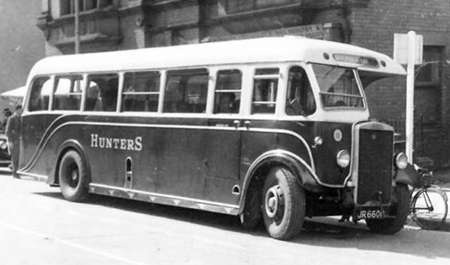
Another from H W Hunter and Sons. New to them in 1937, JR 6600 was a B35F Burlingham bodied Leyland TS7.

Hunter’s - Leyland Tiger TS7 - JR 6600
Photograph by ‘unknown’ if you took this photo please go to the copyright page.

In 1954 it was rebodied by Roe as a B39C, so it was around at the same time that they had the two Titans previously featured on this site. I’m 90 per cent sure they had another Leyland single decker but I’ve been unable to trace it. They had a well deserved reputation that you could virtually set your watch by Hunter’s bus and in addition to the service vehicles they had several coaches, all either AEC or Leylands, although they later switched to Volvo’s. They escaped becoming part of NBC and the formation Tyne and Wear PTE didn’t seem to affect them much because their depot and most of their single route were outside the area controlled by the PTE, so they were more or less allowed to continue much as before. However, I think the PTE may have had some influence over the decision to extended the route from North Shields beyond Seaton Delaval to Cramlington. The huge operational area covered by the pre NBC United Automobile Services empire was split up into bite size pieces prior to deregulation, and the area between the Tyne and the Scottish border was taken by the newly formed Northumbria Motor Services, which was in effect a management buyout. I don’t know the circumstances and I wouldn’t want to speculate, but Hunter’s became part of the Group. I think the name lived on for a while, but Northumbria Motor Services were swallowed up by Arriva, and like many other independents the name of W H Hunter is now, just a memory.

Photograph and Copy contributed by Ronnie Hoye


02/01/13 – 07:50

That is a huge seating capacity for a pre-war halfcab chassis. Was it extended when it was rebodied?

Eric Bawden


02/01/13 – 09:06

I wondered the same thing, Eric, and whether it was a road-based prototype for the "economy class" of airline seating!

Pete Davies


02/01/13 – 16:53

A most interesting question and 39 does seem a lot of seats in a vehicle of , presumably, 27’6" length. One would also have thought that a centre doorway, as opposed to the previous front door, might well reduce the available seat space. However, as the two pictures are taken from roughly very nearly the same perspective the vehicle appears to be the same length in both. It was unusual, but not unknown, for normal length prewar buses to have more seats than ideal space wise, but even the lightweight Lions and Cheetahs taken over by Samuel Ledgard in 1943 from the widow of G.F.Tate of Leeds originally seated 39 in their delightfully "old fashioned" Barnaby bodies.

Chris Youhill


02/01/13 – 17:35JR 6600_cu

I’ve given all the information I could dig up and I don’t know if the chassis was extended, but two things look a bit odd to me. On the Burlingham body, if you look at the seat above the letter ‘H’ it gives the impression that the seats over the rear axle appear to be facing each other, also the wheels are fairly flush to the side of the vehicle, whereas on the Roe they look to be slightly inboard, as if the vehicle has been widened but the axle length is still the same, or is it me?

Ronnie Hoye


03/01/13 – 06:42

7ft 6in chassis and original body, but 8ft new body, perhaps? If so, this wouldn’t be the only one, and they do look a bit strange!

Pete Davies


03/01/13 – 06:43

Ronnie, I would agree with you that the Roe body looks to be 8ft on a 7ft 6in chassis. The Roe body also has an extra window bay to the Burlingham.
It may be purely body style but the body overhang behind the rear axle looks to be longer on the Roe than the Burlingham, certainly, there are almost two full window bays behind the wheelarch on the Roe as against one and a half on the Burlingham. Also if you look at the exhaust tailpipe it appears to be in the same position in relation to the back axle in both photos yet the Roe overhang, again seems to be longer.
Don’t know if it has anything to do with this discussion but the front wheels, despite the absence of nutguard rings on the Roe are different to those fitted in the Burlingham picture.
As this body looks to be almost identical to the centre entrance Guys placed in service with Darlington in 1952/3 I wonder if Hunter’s body was tagged on to the end of the Darlington order, a not uncommon occurrence at Crossgates Works, even into the ’70s. I believe Darlington’s Guys were B41C.
Has anyone a nearside view of this bus with its Roe Body?

Eric Bawden


03/01/13 – 06:44

My word Ronnie, I think you’ve hit on two very pertinent features there for sure. As regards the "inset" appearance of the wheels on the newer Roe body I would say that the replacement coachwork is eight feet wide on the unaltered 7’6" TS7 chassis – a practice not unknown in the 1950s especially on single deckers. Your enlargement of the area above the "H" of Hunters reveals an interesting feature. The "A" shaped seat back appears to be a joint support for two seats, one on the left facing backwards and sharing the floor space with a forward facing seat to its rear, and one forward facing one on the right. The four passengers (plus four on the nearside) in the facing seats no doubt had to put their feet on the slightly intruding wheel arches. What a wonderful vehicle in both its forms !!

Chris Youhill


03/01/13 – 06:44

To my eye the newer body looks longer, though not much – the typical Roe high domed roof tends to mask this. 39 seats would mean 10 rows on the offside, 9 on the nearside (both including the rear 5-some). That sounds awfully tight in a length of 27’6" – minus the length of the cab and thickness of the front bulkhead.

Stephen Ford


04/01/13 – 06:45

Eric, I typed JR 6600 into my search engine, and up came the Park Royal vehicles site with what I take to be a pre delivery photo taken outside the Roe works. It differs slightly from the Darlington Guy’s, as when the doors are closed they form part of the side of the bus, whereas the platform steps are exposed on the Darlington vehicles.

Ronnie Hoye


04/01/13 – 17:43

Thanks Ronnie. After initial difficulty I eventually found the photo on the PRV site.

Eric Bawden


08/01/13 – 07:43

Noting some of the concerns about fitting 39 seats into a body on a 27’6" chassis so earlier today I took a tape measure to a 1952 Roe body with 39 seats although in an overall 30′ chassis and with a front entrance.
Putting 5 seats across the rear leaves a further 34 seats to be fitted by means of 9 sets of double seats on the offside and a further 8 sets with a door on the nearside. The length of the 30 footer from the bulkhead to the rear of the final pair of seats at the back was 22’2" with a gap of 29.5/30" between the same points on adjoining seats.
Turning to the shorter 27’6" bus under review and allowing the same distance from the front of the bus to the front bulkhead and similar requirements for the rear seats leaves circa 19’6" for the 9 sets of seats on the offside and would allow a gap of just 25" between the same point each set of adjoining seats. To me that looked a rather tight fit so I measured the seat gaps on some others from that era and all of them were in the range of 28-30"
To reduce the gap between seats by 5" in the 1950’s would, in my opinion, require smaller seat bases or otherwise it would be impossible to fit your legs in.

Andrew Beever


08/01/13 – 10:42

Andrew: Although I agree that the extra seats would be tight, your maths isn’t quite right. With a 39 seater there are 10 rows of seats on the offside, including the back bench seat. On the basis of your 29.5" pitch, the overall length of the 10 rows is 295". Reduce this by 30" and the ten seats now have to fit 265", so the pitch is 26.5". You lose 3" per seat, rather than your 5". I am over 6 ft, with long legs, and can just make a 27" pitch with a thin seat back with my legs straight, so the average person just about fits OK. Birkenhead used to cram 66 seats onto a PD2 without a 3 seater at the back or a television seat. Those seats were definitely tight for me, and probably similar in pitch to 39 on a 27ft 6in half-cab.

Alan Murray-Rust


08/01/13 – 13:43

Alan, I had specifically excluded the rear seat in my calculations since this seat is effectively fitted into the rounded rear corners with very limited foot room under it.

Andrew Beever


15/01/13 – 16:38

Hunter 21 (JR 6600) had Roe body GO3827 when rebodied 3/54.
Hunter 20 (JR 4901) was the other Leyland TS7 10076 rebodied by Roe in 4/53 (GO3680) also squeezing in 39 seats in its centre entrance body.
Hunter did, of course, have another new Roe body. Fleet number 30 was WTY 843J, a Leyland PDR1A/1R, with H43/29D bodywork

MikeB


16/01/13 – 10:48

Thanks for that, Mike, I’ve been racking my brains, or rather what little is left of them. I knew they had a second Tiger but I’ve been unable to find any records of it, did that also start life with a Burlingham body?

Ronnie Hoye


27/01/13 – 10:30

I’m sure the two single deckers were VTY 360. & TJR 573 this I have to say is from memory many years ago.

Bob Mandale


28/01/13 – 08:40

Bob, MikeB came up with the answer I was looking for. The two single deck buses you refer to were the replacements for JR 4901 and 6600. They were AEC 2MU3RV’s with Plaxton Highwayman B45F bodies. TJR 573 was delivered in 1961 followed by VTY 360 in 1962 (VTY 360 is coming as a separate posting soon). By that time the chassis on 6600 was nigh on 25 years old and from the registration I would estimate 4901 to be a couple of years older. Apart from WTY 843J mentioned by MikeB, I believe the two AEC’s were the last new service buses bought by Hunter’s as all subsequent vehicles were either coaches or D/P’s

Ronnie Hoye


03/04/15 – 05:31

Further to the discussion on the length of JR4901 and JR6600, can I mention that these two vehicles had a rear-facing seat for five across the front bulkhead, and an inward facing single seat on the nearside just ahead of the centre entrance. I also think that the entrance may have been slightly wider than usual for a single decker of that era. I don’t recall the seat spacing as being especially tight, so I would think that the bodies must have been slightly longer than the original ones. Incidentally, the original body above is described as B34F, but it looks to me to be a coach body.

John Gibson


01/06/15 – 07:20

There was a heck of a lot of rebodying of half cab single deckers from 1950 as 38 or 39 seaters once the 27′ 6" maximum length had been increased to 30 feet.
However, all is not what it seems. Buses for Trent, North Western and Potteries and the Hunter’s Tiger were lengthened without any alteration to the wheelbase of 17′ 6" because the C&U Regs until 1961 allowed the rear overhang to be up to 50% of the wheelbase. With a front overhang of about 2′ 3" on, say, Gardner 5LW or AEC 7.7 engined chassis – and a rear overhang of 8′ 9" it was legal from 1950 to go to a maximum length of 28′ 6" without altering the wheelbase. This was sufficient for another row of seats to be fitted without any alteration of the chassis.
Indeed, I think it was only Yorkshire Woollen District which actually lengthened the wheelbase of its Willowbrook bodied PS2s to 18′ 9" when they lengthened them to 30 feet.
Many of the Leyland PS’s taken over by Potteries in the early fifties were already 28′ 6" long and may have inspired PMT to rebuild its Weymann single deck 17′ 6" wheelbase OPD2s by substituting a 2′ 7" long bay for a possible rear door with a 3′ 7" long standard window bay, increasing the seating capacity in the process.

Alan Johnson


Quick links to the  -  Comments Page  -  Contact Page  -  Home Page


All rights to the design and layout of this website are reserved     

Old Bus Photos from Saturday 25th April 2009 to Wednesday 3rd January 2024